

What if you were driving around on a bomb just waiting to explode?
That sounds pretty dramatic, but it’s a good description of cars with the wrong amount of tire pressure.
Unfortunately, many drivers don’t know how often to check tire pressure. With our complete guide, you’ll know how often to do it and just how important your tire pressure really is to your regular car maintenance.
How Often To Check Tire Pressure
How often, then, should you check your tire pressure? At a minimum, you should check the pressure at least once a month.
By effectively inspecting your tires 12 times a year, you can keep a solid eye on your tire pressure and fix things before they get out of hand. And, remember, both underinflation and overinflation are pretty dangerous (more on this later).
Some drivers like to play it even safer than that. For example, you may want to check your tire pressure every time that you drive. That may sound like a lot, but it doesn’t actually take much time or effort to check your tire pressure.
What Do You Need To Check Tire Pressure?
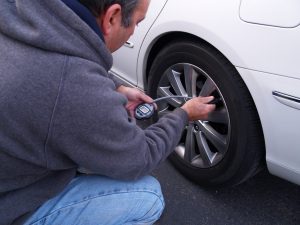
Exactly what tools do you need to check your tire pressure? Most of the time, the answer to that is a pressure gauge.
Generally, a good pressure gauge costs between $10 and $20. You don’t necessarily want to get something cheaper than that. After all, “you get what you pay for,” and this will affect your safety on the road.
With certain newer vehicles, you may not even need a gauge. That is because such cars may come with an automatic tire pressure monitoring system. This lets you get an accurate tire pressure readouts with a press of the button.
If you have such a system in your car, you should check your tire pressure whenever you drive. However, as we have detailed below, you may still want to manually check the pressure with a gauge from time to time.
How To Check Tire Pressure
If you have a tire pressure monitor system, you may be tempted to throw the pressure gauge out. However, it’s still in your interest to manually check the pressure at least once a month.
That’s because most tire pressure monitor systems are like your low fuel light. They don’t really give you an alert until things are pretty bad!
For example, many tire pressure monitor system doesn’t warn you about the pressure until it goes 25% percent below the manufacturer’s recommendations. If you’d like to stay on top of things and notice small drops sooner, you’ll need to monitor things with a gauge.
Speaking of manufacturer recommendations, you’ll need to check your car’s manual to find their tire pressure recommendations for your vehicle. Keep in mind that the manufacturer may recommend slightly different pressures for your front wheels versus your back wheels.
Similarly, there may be different recommendations for extended highway driving versus standard city driving. And certain vehicles (especially light trucks) may have different recommendations based on how much weight the vehicle is carrying at the time.
What If The Tires Are Underinflated?
In all likelihood, you’ve driven on underinflated tires before. You may just not have known what the warning signs were. So what is likely to happen if the tires are underinflated?
First, the tire will come into contact more directly with the road. That’s because with less air in the tire, the tire is flatter on the ground. Even if you fix things pretty quickly, driving around on such a tire is likely to lead to shoulder wear.
Due to the tires becoming more flexible, underinflated tires will offer more resistance as they roll. This means a tank of gas isn’t going to take you as far as it once did.
Most dangerously, underinflated tires may lead to a car that is less responsive, harder to handle, and slower to brake. In the event of an emergency, this could lead to a car wreck and the potential loss of life.
What If The Tires Are Overinflated?
So far, we’ve focused largely on the dangers of underinflated tires. But what if you end up putting too much air in to “fix” things? In that case, you open yourself up to even more dangers.
Rather than being flat like underinflated tires, an overinflated tire is actually highly rigid. That means your tire’s contact patch won’t contact the road as much, making every ride feel hard and disjointing.
This can lead to uneven tread wear, especially on your center tread. Visually, you may notice that the center tread is smooth and worn-down while the sides of the tire still have tread on them.
Relatively speaking, overinflated tires are less dangerous than underinflated ones. However, these rigid tires are likelier to pop when they encounter potholes or other road hazards. That means each overinflated tire is a blowout waiting to happen.
The Effects of Temperature
Even if you take perfect care of your tire air pressure, you are going to see some variance across the seasons. And that is because the temperature can have some very dramatic effects on tire pressure.
Generally speaking, colder weather can cause tire pressure to drop and warmer weather can cause tire pressure to increase. This will happen regardless of how much you drive your vehicle or otherwise take care of your tires.
Changing seasons should impact how often you manually check the air pressure in your tires. You may only be doing it once a month, but if you experience a serious external temperature, you may want to go ahead and check that your tires are safe to drive.
What’s Next For You And Your Tires
Now you know how often to check tire pressure. Eventually, though, you’ll need to replace the tires and even replace the entire car.
We specialize in keeping you and your family on the road in both safety and style. To see how we can take care of your every automotive need, contact us today!
Connect with us


